.png?width=670&height=63&name=Group%20689%20(1).png)
About the Training
You will now participate in the second part of the Reading Journey training – Theories.
In this section, we go through The Simple View of Reading, A simple explanation of reading.
Course content
- Introduction to The Simple View of Reading
- Become a habitual reader
- With The Simple View of Reading in mind
- In your teaching


Introduction to The Simple View of Reading
In this part, introduction to The Simple View of Reading, you get a simple explanation of the abilities required to learn to read and understand what you read.
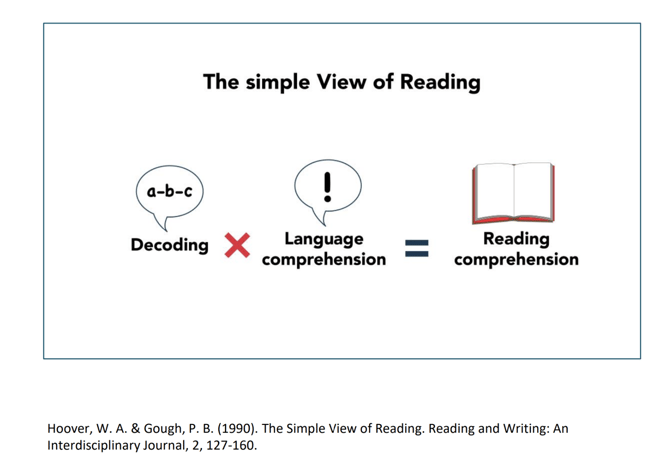
The image shows a visualisation of The Simple View of Reading
Decoding - connecting sounds and letters, connecting
letter sounds to words and sentences.
Linguistic understanding - vocabulary, concepts, grammar and experiences
Both decoding and linguistic understanding are needed for the student to understand a read text.
Become a habitual reader
You have now learned more about the different reading steps and The Simple View of Reading.
In the film, you can practice and maybe get new angles to the various theories.
With The Simple View of Reading in mind
You will now get two examples of how the thinking behind The Simple View of Reading can affect the student.
First student, Amy
Amy has difficulty with reading. She has weak decoding. It goes slowly, and she gets no context in what she reads. But Amy has a good linguistic understanding, she has a good understanding of words and has grown up in a home with a rich linguistic environment, so she can often be helped by the fact that she recognises words that she reads.
If Amy were to read all the text with her eyes, it would be difficult for her to work on comprehension, not only in English but in all other subjects as well.
Amy, therefore, needs the support of read-in texts. She will still practice decoding at her level.
However, as a teacher, you must distinguish between "learning to read" (decoding) and "reading to learn" (understanding and acquiring knowledge)
Second student, Tom.
Tom has difficulty with reading. But he has a fast reading pace, and it sounds
"nice" when he reads. You may react that he slows down when he
reads longer and more complex words.
When Tom has assignments where he has to answer questions about the text he just read, he finds it difficult. He may often ask about the meaning of words or misunderstand the content.
Tom has difficulty with language comprehension.
Tom is greatly helped by the fact that the teaching takes place together in the classroom, where you, as the teacher, talk to the students about texts, both which you read aloud and which they read themselves.
It is also good to review concepts before Tom works on a new work area, for example, in the science or history.
Remember that students with another mother tongue often have difficulty with linguistic understanding.
In your teaching
Now imagine you are in your classroom!
Do you remember the descriptions of Amy and Tom that you just read about?
🤔Now, think about your students!
- Do you have any students who fit the descriptions?
- How do you usually teach them reading?
- Thinking about what you just read, could you teach in any other way?

Well done ⭐
Now that you’ve completed the course, The Simple View of Reading,
Welcome to the next course, The Reading Journey - In Theory - Part 3. In that part, you’ll learn more about what reading strategies really are and why they are so important.
Please press the link below to mark the course as completed.