---
title: The reading journey in Theory 3 - Reading strategies
description: Explore effective reading strategies and how they can strengthen comprehension. This course explains why and how to teach reading strategies, showing practical ways to integrate them into everyday classroom reading.
---
[Skip to content](https://info.lexplore.com/en/support/the-reading-journey-in-theory-3-reading-strategies#main-content)

- Infobank
- [Go to Lexplore.com](https://lexplore.com/old-home)
- [Create a support ticket](https://info.lexplore.com/en/support/lexplore-customer-support-channels)
- [🇸🇪 SV](https://info.lexplore.com/sv/support)
- [🇳🇴 NO](https://info.lexplore.com/no-no/support)
Open main navigation
Close main navigation
- Infobank
- [Go to Lexplore.com](https://lexplore.com/old-home)
- [Create a support ticket](https://info.lexplore.com/en/support/lexplore-customer-support-channels)
- [🇸🇪 SV](https://info.lexplore.com/sv/support)
- [🇳🇴 NO](https://info.lexplore.com/no-no/support)
Hello, how can we help you today?
- There are no suggestions because the search field is empty.
1. [Knowledgebase](https://info.lexplore.com/en/support?hsLang=en)
2. [Academy](https://info.lexplore.com/en/support/academy?hsLang=en)
3. [The Reading Journey - Theory](https://info.lexplore.com/en/support/academy?hsLang=en#the-reading-journey-theory)
# The reading journey in Theory 3 - Reading strategies
## ⏱️ 7 minutes
### ****
### **About the Training**
You will now participate in the second part of the *Reading Journey* training – *Theories*.
In this section, we go through *Reading strategies*and you learn what reading strategies are and why they are so important.
---
### **Course content**
**Reading strategies**
- [Introduction to Reading Strategies](https://info.lexplore.com/en/support/the-reading-journey-in-theory-3-reading-strategies#introduction-to-reading-strategies)
- [Therefore, you should teach reading strategies](https://info.lexplore.com/en/support/the-reading-journey-in-theory-3-reading-strategies#therefore-you-should-teach-reading)
- [Effective reading strategies](https://info.lexplore.com/en/support/the-reading-journey-in-theory-3-reading-strategies#effective-reading-strategies)
- [How reading strategies should pervade reading](https://info.lexplore.com/en/support/the-reading-journey-in-theory-3-reading-strategies#how-reading-strategies-should)
- [Reading strategies in your classroom](https://info.lexplore.com/en/support/the-reading-journey-in-theory-3-reading-strategies#reading-strategies-in-your-classroom)

---
### 
### **Introduction to Reading Strategies**
#### Now you will learn more about reading strategies and why they are so important.
### .png?width=670&height=247&name=nedladdning%20(1).png)
*Said by Adrienne Gear ( Gear , A. ,2019, Reading Power: Activate students' thinking
when they read, Nature and Culture, Stockholm*
******
---
### **Therefore, you should teach reading strategies**
**Teaching Reading Strategies**
Reading strategies are valuable techniques that aid in comprehending texts. These techniques involve identifying keywords, forming mental images, and asking various questions. When we actively employ these strategies, we enhance our grasp of the text's main ideas, details, and overall context.
By introducing students to these reading strategies right from the start of their reading journey, they acquire useful tools to better comprehend what they read. This early understanding of the text not only boosts motivation and enjoyment in reading but also imparts a sense of purpose to the students.
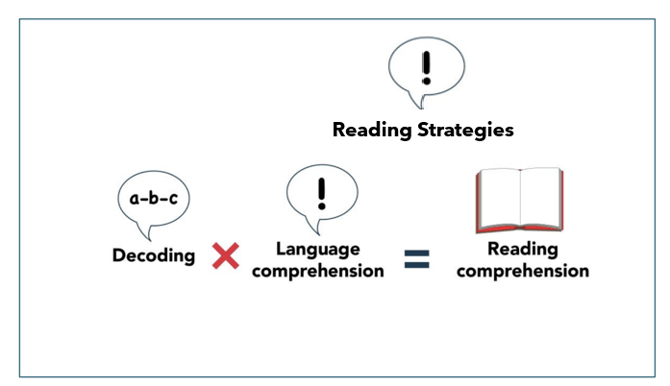
In the introduction to "The Simple View of Reading," you gained an understanding of how decoding and comprehension together contribute to text comprehension. We are expanding the Simple View model of Reading by incorporating reading strategies.
Research consistently demonstrates that these strategies significantly aid in and fortify students' comprehension abilities.
***You can read more about the research on the importance of reading strategies[here!](https://www.skolfi.se/other-languages/english/research-summaries/reading-comprehension-and-reading-strategy-instruction/)***

---
### **Effective reading strategies**
#### Now you know that reading strategies help the reader to consciously and purposefully use different ways of understanding the text they are reading.
There are around 30 different reading strategies that can be divided into three groups.
1. **Memorisation strategies**
Examples can be identifying keywords, re-reading, underlining and retelling. These are
important to give the reader a clear overview of the text. Remember, however,
that they do not contribute to a deeper understanding.
2. **Immersion strategies**
Examples are activating background knowledge, predicting, finding gaps in the text,
close reading, summarising and visualisation. All of these help the reader gain
a deeper understanding of the text.
3. **Control strategies**
Examples of these are asking and answering questions and clarifying the content further. It
also helps to ensure that the reader understands context and context.
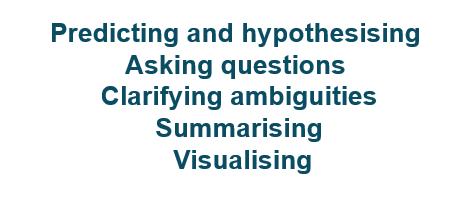
Based on the three main groups, Lexplore has identified five different reading
strategies you probably recognise.

---
### **How reading strategies should pervade reading**
#### Now you will get to read how reading strategies can pervade reading, both when you read aloud and when they read independently.
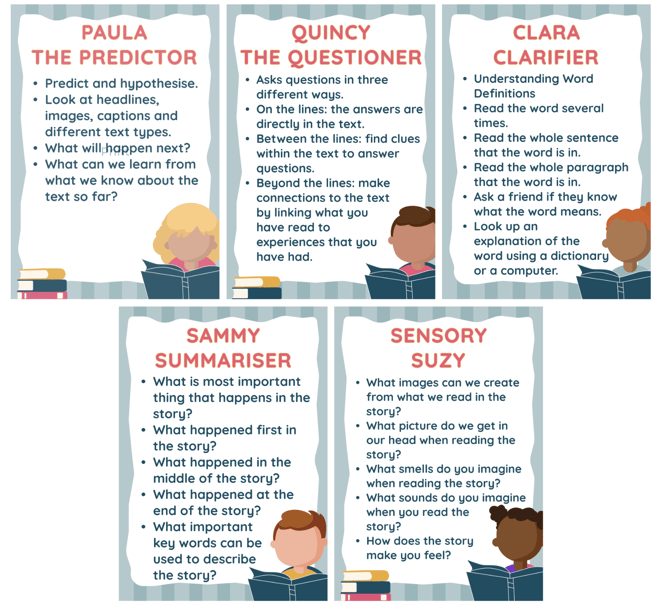
You recognise the picture at the bottom of the page. You can follow the different strategies when you read what each strategy means in practice.
You can teach reading strategies even if students cannot read independently. This means that the students (children) can meet the different strategies already in preschool and that the teacher in the preschool class can include reading strategies in their
teaching.
Repeatedly working with different reading strategies and practicing a lot increases the reader's possibility of choosing which strategy fits best with different texts.
You must include strategies that take the reader through the entire process when getting a book or text.
- When the student takes the book off the shelf, they should know how to predict the content/plot by looking at the front cover.
- When the student reads the book/text, they should also know which questions are good to ask themself to get context, just as the student should feel comfortable clarifying various
ambiguities.
- When the student has read the entire text/book, he/she should be able to summarise the content/action differently.
- Another strategy that gives the student good support is to visualise to create internal images of what the student is reading.
**-1.png?width=670&height=144&name=nedladdning%20(2)-1.png)**


---
### **Reading strategies in your classroom**
You probably already use reading strategies in your teaching today. Perhaps there are exercises you would like to develop for the different reading strategies.
Use the list below, check off the reading strategies you want to develope, and do more exercises.
*Feel free to compare your checklist with that of your colleagues. Maybe someone has
tips and maybe you can share yours!*
- **To predict and hypotheise**
- **To ask questions**
- **To clarify ambiguities**
- **To summarise**
- **To visualise**
### **Tip!**
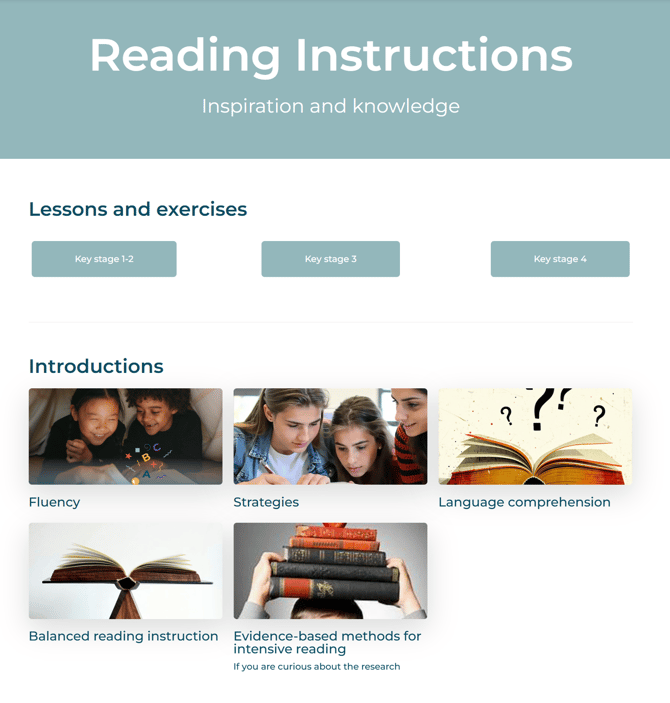
In the portal, on the reading teaching page, you can find lessons and exercises focusing specifically on reading strategies.
These are divided according to the different stages.
There are several lessons and exercises for reading strategies for non-fiction and fiction for all stages.
You also get an introduction to the content and layout of these!

---
### **Well done ⭐**
#### Now that you’ve completed the course, *Reading strategies.*
Welcome to the next course, The Reading Journey - In Theory - Part 4. In that part, you’ll learn about how a balanced reading teaching can make a big difference in reading development.
Please press the link below to mark the course as completed.
[Course completed](https://completecourse.lexplore.com)

- [Getting Started](https://info.lexplore.com/en/support/getting-started?hsLang=en#main-content)
- [Logging in](https://info.lexplore.com/en/support/getting-started?hsLang=en#logging-in)
- [Technical Requirements with an eye tracker](https://info.lexplore.com/en/support/getting-started?hsLang=en#technical-requirements-with-an-eye-tracker)
- [Installation with eye tracker](https://info.lexplore.com/en/support/getting-started?hsLang=en#installation-with-eye-tracker)
- [Administration](https://info.lexplore.com/en/support/getting-started?hsLang=en#administration)
- [Integrations](https://info.lexplore.com/en/support/getting-started?hsLang=en#integrations)
- [Web Assessment](https://info.lexplore.com/en/support/web-assessment?hsLang=en#main-content)
- [Get started with Web Assessment](https://info.lexplore.com/en/support/web-assessment?hsLang=en#get-started-with-web-assessment)
- [Learn more about Web Assessment](https://info.lexplore.com/en/support/web-assessment?hsLang=en#learn-more-about-web-assessment)
- [FAQ](https://info.lexplore.com/en/support/web-assessment?hsLang=en#faq)
- [All about Assessments](https://info.lexplore.com/en/support/all-about-assessments?hsLang=en#main-content)
- [General](https://info.lexplore.com/en/support/all-about-assessments?hsLang=en#general)
- [Preparations before Assessment](https://info.lexplore.com/en/support/all-about-assessments?hsLang=en#preparations-before-assessment)
- [Equipment for performing assessment](https://info.lexplore.com/en/support/all-about-assessments?hsLang=en#equipment-for-performing-assessment)
- [During an assessment](https://info.lexplore.com/en/support/all-about-assessments?hsLang=en#during-an-assessment)
- [After assessment](https://info.lexplore.com/en/support/all-about-assessments?hsLang=en#after-assessment)
- [Administration](https://info.lexplore.com/en/support/administration?hsLang=en#main-content)
- [Student Management](https://info.lexplore.com/en/support/administration?hsLang=en#student-management)
- [Staff Management](https://info.lexplore.com/en/support/administration?hsLang=en#staff-management)
- [Portal functionality](https://info.lexplore.com/en/support/administration?hsLang=en#portal-functionality)
- [Organisation Settings](https://info.lexplore.com/en/support/administration?hsLang=en#organisation-settings)
- [Academy](https://info.lexplore.com/en/support/academy?hsLang=en#main-content)
- [Start with this](https://info.lexplore.com/en/support/academy?hsLang=en#start-with-this)
- [Ambassador courses](https://info.lexplore.com/en/support/academy?hsLang=en#ambassador-courses)
- [Assessments courses](https://info.lexplore.com/en/support/academy?hsLang=en#assessments-courses)
- [Insights & Analysis](https://info.lexplore.com/en/support/academy?hsLang=en#insights-analysis)
- [The Reading Journey - Theory](https://info.lexplore.com/en/support/academy?hsLang=en#the-reading-journey-theory)
- [The Reading Journey - Practical](https://info.lexplore.com/en/support/academy?hsLang=en#the-reading-journey-practical)
- [The Reading Journey/Library - Workshops](https://info.lexplore.com/en/support/academy?hsLang=en#the-reading-journey-library-workshops)
- [Understand and manage the Results](https://info.lexplore.com/en/support/understand-and-manage-the-results?hsLang=en#main-content)
- [Understand the results](https://info.lexplore.com/en/support/understand-and-manage-the-results?hsLang=en#understand-the-results)
- [Navigate the results](https://info.lexplore.com/en/support/understand-and-manage-the-results?hsLang=en#navigate-the-results)
- [Results where review is needed](https://info.lexplore.com/en/support/understand-and-manage-the-results?hsLang=en#results-where-review-is-needed)
- [Manage results](https://info.lexplore.com/en/support/understand-and-manage-the-results?hsLang=en#manage-results)
- [Other](https://info.lexplore.com/en/support/understand-and-manage-the-results?hsLang=en#other)
- [Reading development](https://info.lexplore.com/en/support/reading-development?hsLang=en#main-content)
- [Theory about reading development](https://info.lexplore.com/en/support/reading-development?hsLang=en#theory-about-reading-development)
- [Fluency Practice](https://info.lexplore.com/en/support/reading-development?hsLang=en#fluency-practice)
- [About Lexplore Reading App for students](https://info.lexplore.com/en/support/reading-development?hsLang=en#about-lexplore-reading-app-for-students)
- [Information to guardians](https://info.lexplore.com/en/support/reading-development?hsLang=en#information-to-guardians)
- [Support](https://info.lexplore.com/en/support/support?hsLang=en)
[](https://lexplore.com?hsLang=en)
A clear view of reading
Copyright © 2026, Lexplore Nordic AB