About the Training
You will now participate in the fourth part of the Reading Journey training – Theories.
In this section, we go through Balanced reading instruction. Teaching reading is an art. Balanced reading instruction can make a big difference in reading development.
Course content
Balanced reading instruction

Introduction to the Balanced Reading Teaching
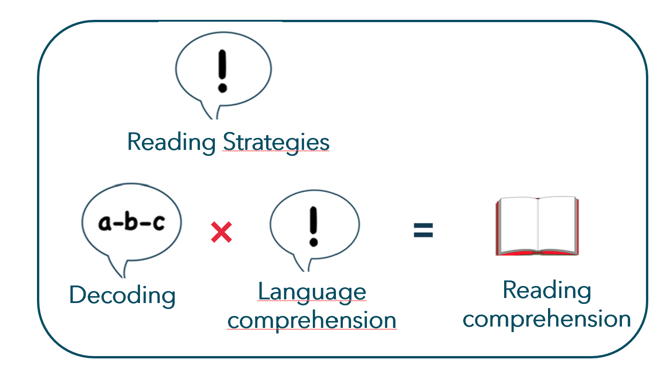
You have now read about The Simple View of Reading, which includes decoding and
linguistic comprehension.
You have also learned more about reading strategies and why you, as a teacher, should teach the different strategies regularly.
You will now be part of a model called Finding a balanced reading lesson. The model should help you and your colleagues plan the reading lesson so that all important parts, that you previously read about, are not forgotten.
Finding a balanced reading lesson is inspired by Reading Power which was created in 2019 by Adrienne Green.
Gear A. (2015) Reading Power, Teaching Students to Think While They Read, Pembroke Publishing Ltd


Reading Power
As you know, several components develop the student's reading.
Power of Reading is a collective term for various parameters and abilities.
The components that Power of Reading includes are
- Vocabulary and concepts
- Reading strategies
- Thinking
- Love of reading
The two previous research theories you read about (The Simple View of Reading and
Reading Strategies) are summarised in Reading Power.
In contrast, Reading Power highlights reading pleasure as an important component, which the previous theories you read about do not focus on.
Reading pleasure and motivation
You now know that reading is complex. You also know that the student's conditions, such as dyslexia or weak language comprehension, play a big role in how the student will succeed on their reading journey.
Having a positive attitude towards reading and feeling motivated is essential to continue reading. When students find books and topics they find interesting, they can also have a deeper and more rewarding reading experience.
For students with reading difficulties, it is even more important to find the love of reading!
All this you are probably already aware of.
Perhaps you are thinking of a student or students right now who have difficulty finding a love of reading. Although these students may never become bookworms, you as a teacher can make it easier for them when they have to read a book or text.
Remember that you have great opportunities to influence the student's interest in reading!
When the reader reads actively, the content becomes more alive.
How do you read actively?
.png?width=670&height=370&name=nedladdning%20(5).png)
Think 🤔
Think about yourself!
- What makes you an active reader?
- What makes you get stuck in a text/book?
- When do you not get stuck in a book/text?
- How do you usually motivate yourself if you still have to read on?
- Is there something you do to increase your motivation that you can bring to your hard-to-motivate students?
Balanced and systematic reading teaching
Finding space for the components that benefit the students' reading development is a challenge.
You will now receive an introduction to a model to help you analyse and plan your reading teaching going forward.
It is important to remember that it takes patience to develop students' reading.
The clearest difference is usually when the students have worked intensively on decoding and reading fluency.
It may take longer to see how they develop their understanding and ability to use different strategies.
On the other hand, you can streamline the teaching to include the various components you previously read about, which the research clearly shows benefits the student's reading development.
- Decoding & Reading fluency
- Language comprehension
- Reading strategies
By repeatedly completing lessons and exercises, you create a necessary system to achieve results!
And you, remember to cooperate with your colleagues and be patient.

The Balanced reading teaching model
You have now read about various components that develop students' reading effectively.
With balanced reading teaching, these components must be included.
So far, you have learned the theories. You should get a concrete overview of activities that practice decoding/ reading fluency, language comprehension and reading strategies.
Based on the theory above, there are a variety of activities that you can carry out together with your students.
To make it easy to conduct a reading lesson that rests on research, we have compiled a number of reading activities that can be part of a balanced reading instruction.
You already know that research-based methods and proven experience should characterise teaching. It can, therefore, be safe to know that teachers with good results have tried all activities recommended in the model.
Of course, you should adapt them according to your students' reading ability
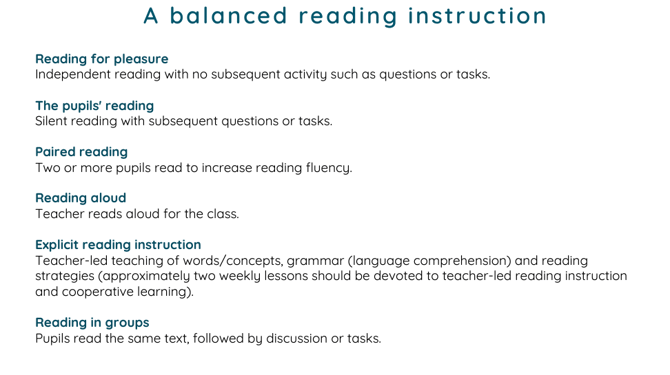
- Own reading - Silent reading with subsequent questions or tasks.
- Pair reading - Two or more students read aloud to each other for increased reading fluency.
- Reading aloud - Läraren läser högt.
- Pleasure reading - Independent pleasure reading without subsequent activity such as questions or tasks.
- Reading groups - Students read the same title with subsequent conversations or tasks.
- Explicit reading instruction - Teacher-led teaching of language comprehension and reading strategies. Around two lessons per week should be devoted to teacher-led reading instruction and collaborative learning ( Gear , 2019). Lessons and exercises that are included in explicit reading instruction can therefore be found on the page for reading instruction (please take part in the Reading Journey - in practice where you will find out more that soon will be available)
Visualisation of the model
Here, you see a visualisation of the model.
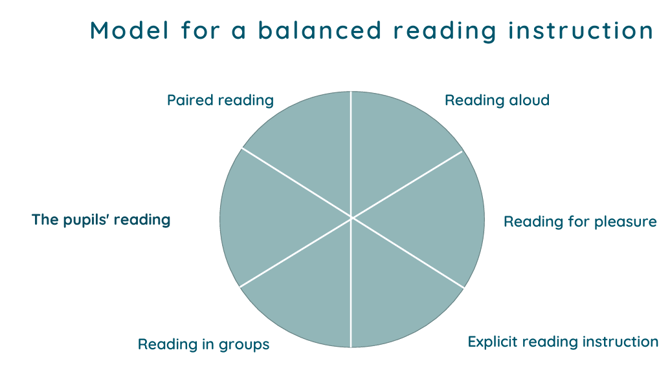
If we visualise that distribution, they can look like this.
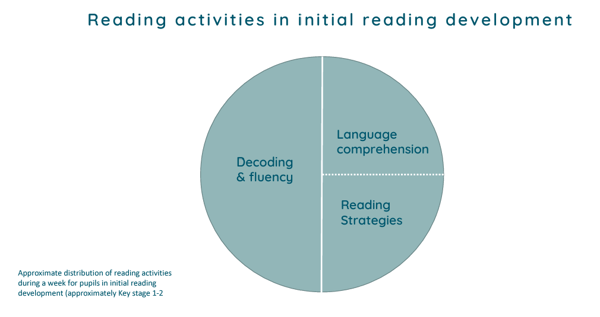
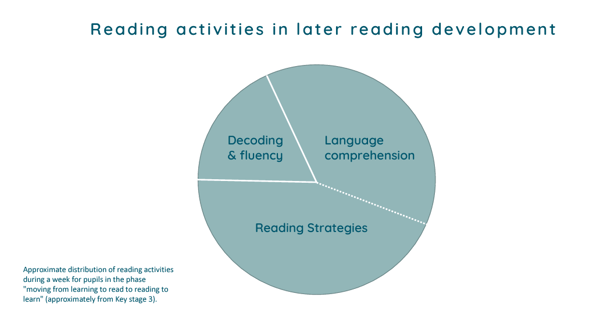
You have previously read about the stages of reading development.
The earlier in their reading development the student is, the greater the focus should be on decoding and reading fluency in order to slowly change the focus to reading instruction
that develops the students' deeper reading comprehension.
Your reading activities
Perhaps you have already started to think about what activities you usually do in your class to develop reading instruction.
You might also think about how you could develop them further.
Now you have to think for a while
- What type of reading activities get the most space in your reading instruction?
- What type of reading activities receive the least space in your reading instruction?
- Is there something that you would like to develop? If so, what?
Use the image and text below!
Well done ⭐
Now that you’ve completed the course, Balanced reading instruction. We invite you to explore our other courses in the Academy.
Please press the button below to mark the course as completed.