.png?width=670&height=58&name=Group%20729%20(1).png)
About the Training
You are about to engage in the second part of two, The Reading Journey.
The aim of the training is to get you started using the lessons and exercises we offer for your reading instruction.
You should feel comfortable with:
- handling the students' reading application
- know how to get insights on students' reading (see what they read, when and how much)
- use the teacher's side of the library, both the reading fluency training that is included and the e-library that is an additional service.
As with the Reading Journey - In Theory we also want the training to inspire you and your colleagues to reflect together. We want you to develop what is already working well, but also to gain new perspectives when working with students' reading development.
By the end of the course, we hope you’ll feel confident and comfortable teaching with the support of Lexplore! 💛

Course content

.png?width=670&height=69&name=Group%20760%20(2).png)
Implementing Balanced Reading Instructions
In the "The Reading Journey - In Theory" course, you could read about the model for balanced reading instruction.
We want to make teaching as simple as possible! Therefore, we have developed lessons and exercises based on various reading
theories. These theories have identified how good reading instruction can be
conducted.
On the Reading Instruction page, you will find lessons and exercises to help you and your colleagues implement good and balanced reading instruction.
We will review what is included and how you can allocate different activities depending on where your students are on the reading ladder.
When you teach a class, there is naturally a wide range of students' reading abilities.
Therefore, all lessons and exercises are adapted so that you start from a common learning ground where you model and try together, and students can practice in pairs or individually.
You can carry out most exercises based on the literature that students read on their own or that you read together.
Feel free to implement the lessons as intended or adapt them to suit your class!
We also want to promote and support a culture of sharing where you and your colleagues share how you implement the various lessons and exercises.
Good luck!

Summary
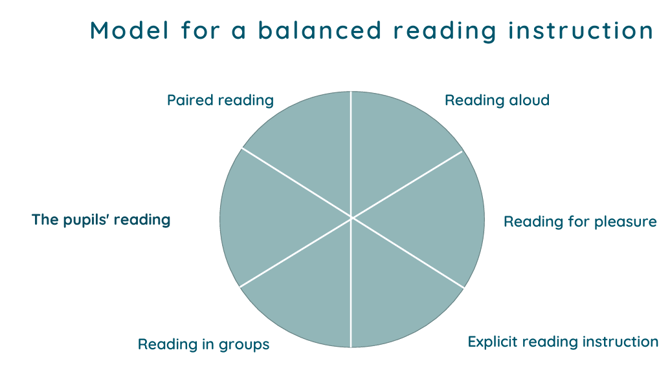
You have previously learned about the different components that balanced reading instruction should include.
Do you remember them?
Don´t worry!
Here's a brief look back at these!
- Reading for pleasure
Independent reading with no subsequent activity such as questions or tasks. - The pupils' reading
Silent reading with subsequent questions or tasks. - Paired reading
Two or more pupils read to increase reading fluency. - Reading aloud
The teacher reads aloud to the class. - Reading in groups
Pupils read the same text, followed by discussion or tasks. - Explicit reading instruction
Teacher-led teaching of words/concepts, grammar (language comprehension) and reading strategies (approximately two weekly lessons should be devoted to teacher-led reading instruction and cooperative learning).
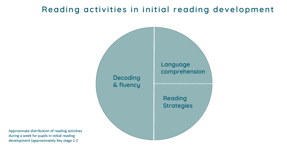
You have previously read about the stages of reading development.
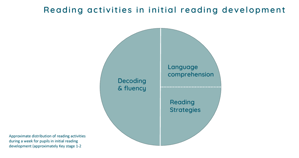
The earlier the student is on their reading development journey, the greater the focus should be on decoding and fluency, gradually shifting focus to reading instruction that develops students' deeper reading comprehension.
Well done ⭐
You have now completed this sub-course. Welcome to the next course, Reading Journey – Practical Part 2. In this course, you will learn more about materials and exercises for your reading instruction.